02-27217300
02-27217179
service@siloahtravel.com
Monday ~ Friday 09:00-18:00
14F.-3, No.137, Sec. 1, Fuxing S. Rd., Da’an Dist., Taipei City 106, Taiwan
Representative: Tung-Hua Tai
VAT: 43871553
交觀甲793500 品保北2260 隱私權條款
IATA: 96137764
Copyright © 2025 Siloah Travel Co., Ltd.. All rights reserved.

Ultramarine
Quark Expeditions


Arrive any time on Day 1 and make your way to the group hotel, which is included in your Charter Flight & Hotel Package. The Scottish city of Aberdeen, your gateway for this adventure, is known as the Granite City, as it was once the granite capital of the world. You’ll understand as soon as you see the grey Victorian buildings—that sparkle in the sunlight. A bustling cultural hub, Aberdeen also offers a range of museums, galleries, theaters, shops, cafés and restaurants to explore.

Today you will have free time before being transferred to the port to board your ship. Upon boarding the ship, you will be welcomed by the expedition team and crew who will provide ship orientation and an introductory briefing of the voyage to come.

Situated just north of mainland Scotland, Orkney is an archipelago of islands steeped in history. Some of Europe’s most intact Neolithic ruins are found here, dating back 5,000 to 8,000 years. Chief among them is Skara Brae, a small community of ten stone homes, situated within earthen dams, that dates to 3180 BCE. Skara Brae is part of the Heart of Neolithic Orkney World Heritage Site, and is considered one of the most important Neolithic sites in all of Europe. Walking among these ancient homes and looking out toward the sea in the Bay of Skaill provides a sense of connection to humans who lived before the Egyptian pyramids were constructed. Papa Westray, a more remote island just north of Skara Brae—and more difficult to access—is also home to an ancient farmstead dating back to 3700 BCE. The surrounding farmlands are peaceful and quiet. The sounds of summer and migratory birds, combined with waves from the North Atlantic Ocean crashing against the shoreline below, seem to transcend time—offering a fleeting glimpse into what life may have looked and sounded like thousands of years ago. Home to more than 70 islands, 20 of Situated just north of mainland Scotland, Orkney is an archipelago of islands steeped in history. Some of Europe’s most intact Neolithic ruins are found which are inhabited, Orkney is a unique region with strong connections to the polar regions. Dr. John Rae, the famous Arctic explorer who helped map the Northwest Passage in the 1830s and 1840s, was Orcadian, and a monument to his achievements stands in the village of Stromness. Several Orcadian place names can be found in the Antarctic, including the South Orkney Islands and the Stromness whaling station in South Georgia. The region is a network of pastoral green islands framed by rugged coastlines and occasional white sandy beaches. These islands—with cliffs ideal for nesting seabirds—are perfectly situated for both seasonal bird colonies and migratory species en route to the Arctic. Birders will find Orkney an excellent place to spot species like Atlantic puffins, northern gannets, razorbills, kittiwakes, Arctic terns, Arctic skuas, and many others. Guests can explore off-ship—as conditions allow—by joining Zodiac, kayak, and paddling excursions, as well as guided and self-guided walks.
Further north, Shetland is another archipelago with a truly unique culture and feel. A fusion of Norse and Scottish history and culture—and a visceral connection to the wind, weather, and sea—Shetland feels like no other place in the UK. Here, we intend to explore the bird colonies of Sumburgh Head, 100-meter (328 feet) cliffs that descend into the rich marine environment below, framed by jagged rocky outcroppings that pierce through the sea. Common species spotted here include Atlantic puffins, guillemots, razorbills, and kittiwakes. Additional marine wildlife in the vicinity includes white-beaked dolphins, minke whales, and occasionally orca and humpback whales. The cliffs themselves are impressive in their rugged beauty, marked by a picturesque lighthouse that serves as an important beacon for mariners transiting the area. Not far from Sumburgh Head, and deeper into the West Voe of Sumburgh, is the world-famous Jarlshof—an archaeological site considered to be among Europe’s most important. Situated among soft green pastoral farmland, and just above a beautiful sandy Scottish beach, the area showcases thousands of years of human history, with Neolithic, Bronze Age, Iron Age, and Viking sites all immediately visible and within close proximity to one another. Roundhouses from the Iron Age, circa 400–800 BCE, are well-excavated, as are longhouses and stone walls from the Viking Age. Additionally, the Old House of Sumburgh—dating to the 15th century, when Shetland passed from Norse to Scottish control—stands among ruins that are thousands of years older. Jarlshof is a true tapestry of history, with many layers and eras woven together. There are plenty of opportunities to be active on this journey. We’ll take to the Zodiacs to explore the coastal shorelines for cruising as well as shore landings. If weather permits, we’ll deploy our sea kayak and paddle programs. And whenever you’re back on the ship, head to the outer decks—especially as we approach our excursion sites—for birds and marine mammals.


While at sea, be sure to spend time on the outer decks to watch for resident seabirds and migrating birds, or enjoy the views through the floor-to-ceiling windows. We will ride the relatively warm current north—the same current that helps keep the Norwegian coast and west coast of Svalbard relatively temperate. While onboard, your Expedition Team will share their knowledge and expertise through scheduled presentations on ornithology, biology, history, and geology, as well as through informal interactions throughout the voyage. Your at-sea days provide ample opportunity to enjoy the amenities onboard Ultramarine: the Tundra Spa & Sauna, the fitness centre, the library, or one of several lounges where you can enjoy a drink with fellow travelers.

Situated more than 400 kilometers north of mainland Norway, where the Greenland, Norwegian, and Barents sea converge, Bear Island is the gateway to Svalbard—and home to prolific bird populations. Visiting is a special privilege, as the island is rarely accessed due to its isolation. But it’s well worth the effort. More than 1.5 million birds flock to Bear Island each year. Hundreds of thousands nest on its near-vertical cliffs, where they can forage in the rich marine environment. If wind and waves allow, it’s possible we’ll offer a Zodiac cruise here along cliffs teeming with birds, with a constant procession coming and going from their nest sites. Little auks, Brünnich’s guillemots, common guillemots, kittiwakes, and northern fulmars are found in prolific numbers, alongside smaller colonies of Atlantic puffins. Many more migratory birds use the island as a critical stopover on their annual journey to the Arctic. On a map, Bear Island appears small. But by Zodiac, its cliff walls—some rising more than 400 meters (1,310 feet) from the sea—feel colossal. Shorelines are fully exposed to the open ocean, with waves crashing in an astounding display of nature’s power. A few sheltered coves— used by whalers, sealers, explorers, and researchers from the 16th to 21st centuries—may offer us a chance to explore this wild outpost at the gates of Svalbard. In early May, we may see hints of green emerging from an otherwise snowy landscape. Arctic foxes may be spotted on shore, eagerly awaiting the return of birds and their eggs. If conditions allow, we’ll make landfall, walking where few humans ever do. Remnants of whaling history from the early 17th century, along with more recent traces of meteorological and military activity, can be found here. Still, despite any human presence, the island retains a powerful sense of wilderness.

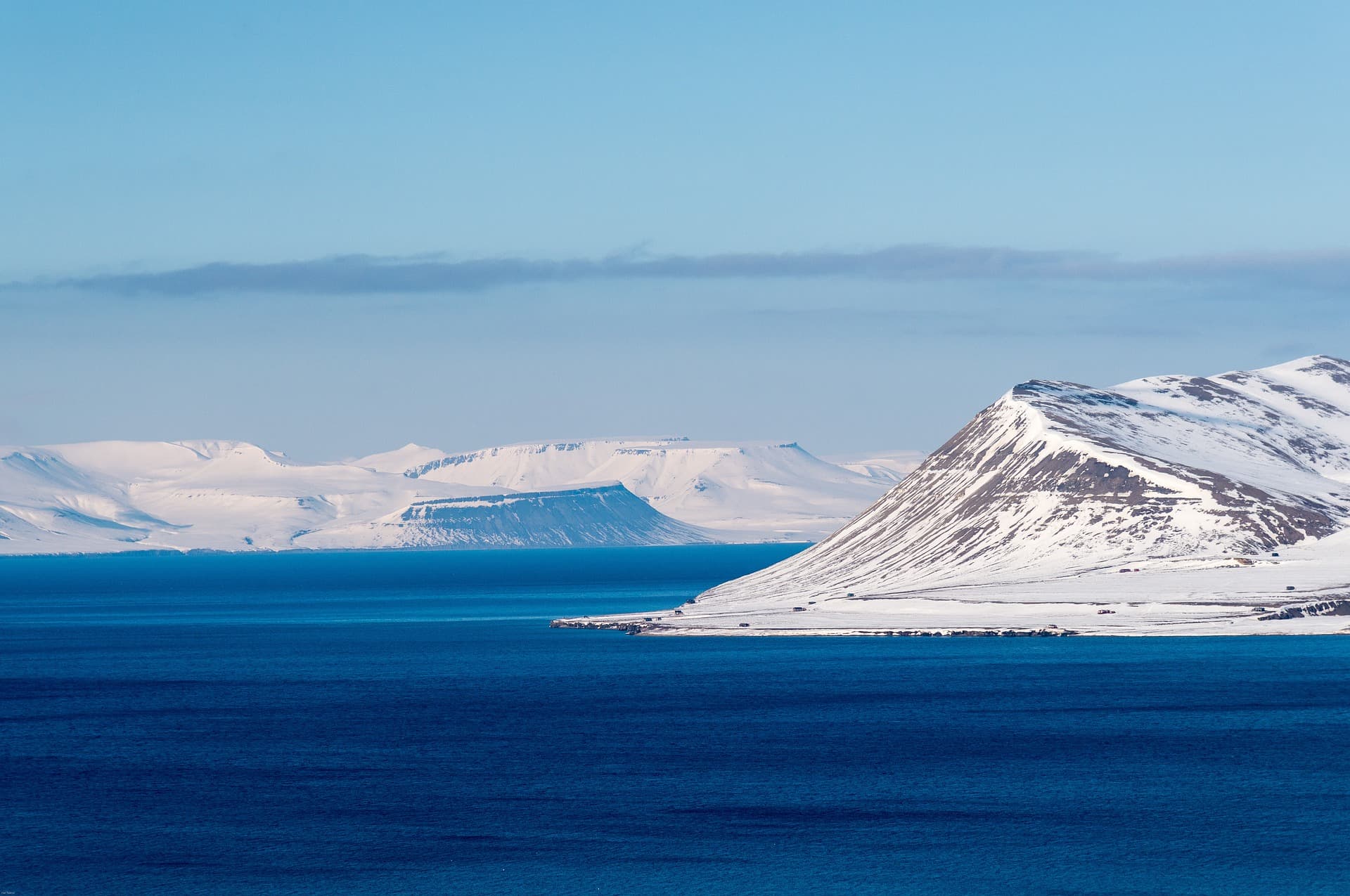
Our introduction to Svalbard begins in Storfjorden, a wide fjord in southern Svalbard that is often dense with sea ice in May. How far we travel will depend on current ice conditions. Sea ice is dynamic, capable of shifting dozens of kilometers in a day, and we’ll adapt accordingly to f ind the best opportunities to explore this keystone feature of the Arctic. We may spend considerable time here, navigating by ship and Zodiac along the ice edge in search of iconic wildlife such as polar bears and walrus, both drawn to the life-giving sea ice. Wildlife movements are unpredictable, so keep your binoculars close—you never know when something may appear. Your Expedition Team will share insights into the region’s features and history as we explore. If conditions allow, we may even step onto the sea ice itself. Whether on foot or by Zodiac, encountering Your Expedition Team will share insights into the region’s features and history as we explore. If conditions allow, we may even step onto the sea ice itself. Whether on foot or by Zodiac, encountering

Our introduction to Svalbard begins in Storfjorden, a wide fjord in southern Svalbard that is often dense with sea ice in May. How far we travel will depend on current ice conditions. Sea ice is dynamic, capable of shifting dozens of kilometers in a day, and we’ll adapt accordingly to f ind the best opportunities to explore this keystone feature of the Arctic. We may spend considerable time here, navigating by ship and Zodiac along the ice edge in search of iconic wildlife such as polar bears and walrus, both drawn to the life-giving sea ice. Wildlife movements are unpredictable, so keep your binoculars close—you never know when something may appear. Your Expedition Team will share insights into the region’s features and history as we explore. If conditions allow, we may even step onto the sea ice itself. Whether on foot or by Zodiac, encountering Your Expedition Team will share insights into the region’s features and history as we explore. If conditions allow, we may even step onto the sea ice itself. Whether on foot or by Zodiac, encountering

After excitedly exploring the open sea ice, we’ll continue toward Svalbard’s west coast for a closer, more intimate encounter with the wilderness of the archipelago. Our first day will be spent in and around Hornsund, a region of striking landscapes, mountains, glaciers and icebergs. Sea ice may still be present, and if so, we’ll watch for wildlife whose lives depend on it for food and survival. Our aim is to explore the fjord by Zodiac and on foot, though you should expect plenty of snow underfoot. Hornsund is home to several tidewater glaciers, which we hope to approach by Zodiac. Icebergs mix with brash and sea ice, creating a unique crackling soundscape that echoes the rhythm of the Arctic. Surrounding us, 800 to 1,400-meter (2,625 to 4,593 feet) peaks rise beneath Midnight Sun skies, the kind of scene many envision when dreaming of the High Arctic. Watch for Arctic fox, often seen in the area. Seabird colonies thrive here too, a reminder of the epic migrations these species undertake each spring to reach Svalbard—and again each fall as they return south.

Moving north up the coast, we enter another large fjord with many smaller branches, each worth exploring. Bellsund, much like Hornsund, features several tidewater glaciers, which we aim to visit as conditions allow. It’s also home to a remarkable little auk colony, which we’ll approach by Zodiac to observe the early summer activity. Birder or not, it’s hard not to admire these small, resilient birds, perfectly adapted to this seemingly harsh environment. By late spring, skies over the colony are thick with birds, and we hope to witness the start of this seasonal spectacle. Reindeer are often spotted here too, and we’ll be watching for them. The landscape is iconic—snowcapped peaks layered in all directions, jagged rocky outcrops, and soft, snow-covered plains. If conditions allow, we’ll go ashore, though even in May, snow is likely.

Overnight, we’ll push far up the coast to Krossfjorden, just 660 nautical miles from the North Pole. We aim to explore as much of the west coast as possible, as this dramatic fjord lies along a stretch of coastline shaped by a relatively warm current flowing from south to north—creating a surprisingly temperate environment compared to the harsher conditions farther north and east. Depending on ice and weather conditions, we hope to venture deep into the fjord to iconic sites such as Lilliehookbreen—a stunning tidewater glacier where seals often haul out on floating ice. The landscapes here blend the gentle and the dramatic—a picture-perfect scene of northern wilderness. To add variety to your photographs, consider experimenting with black and white photography, as the textures of mountains, valleys, snow, ice, and clouds can create striking images. You may also spot Arctic foxes, whether out on the ice or along the hillsides above, and seabird colonies occupy several of the cliffs deeper in the fjord. Avid birders should keep an eye out for king eiders. While Longyearbyen holds the title of northernmost city in the world, the northernmost settlement—Ny-Ålesund— lies in Kongsfjorden, a southern offshoot of Krossfjorden. Originally a coal mining outpost over a century ago, it now serves as an important year-round research station. Take a moment to soak in the surroundings and imagine what life must be like when the sun doesn’t set for months. Conversely, consider the challenges of staffing a research station through the long polar night, when the sun doesn’t rise for months.

Today marks the northernmost point of our journey—just over 1300 kilometers (800 miles) from the North Pole. That’s comparable to a day-long road trip from St. Louis, Missouri, to Washington, (or Berlin to Milan or Brisbane to Canberra, Australia) yet here, it leads straight into the heart of the Arctic. As we look north from Smeerenburgfjorden, a striking fjord in northwest Svalbard, we can envision a wilderness covered in sea ice, stretching across the cap of the northern hemisphere all the way to Alaska. It’s theoretically possible to travel in a straight line to Greenland, Canada, Siberia or Alaska without encountering any land in between. Sea ice may lie just north of the coastline—or dozens of nautical miles offshore—depending on the currents and how the ice is moving at the time. Deeper into the fjord, we hope to land at a known walrus haulout: a sandy beach often covered in snow but used by walruses throughout the year. Arctic terns, among the world’s most impressive migratory species, nest in the fjord, and we may see them flying overhead as we travel by foot or Zodiac. From the walrus haulout, mountain ranges stretch across the f jord, evoking a sense of standing at—or beyond—the frontier. Evidence of human activity remains: relics of whaling and sealing industries dating back to the 1600s are still visible onshore. Not full-scale factories, but trypots—used to render whale blubber into oil—remain scattered about the area.

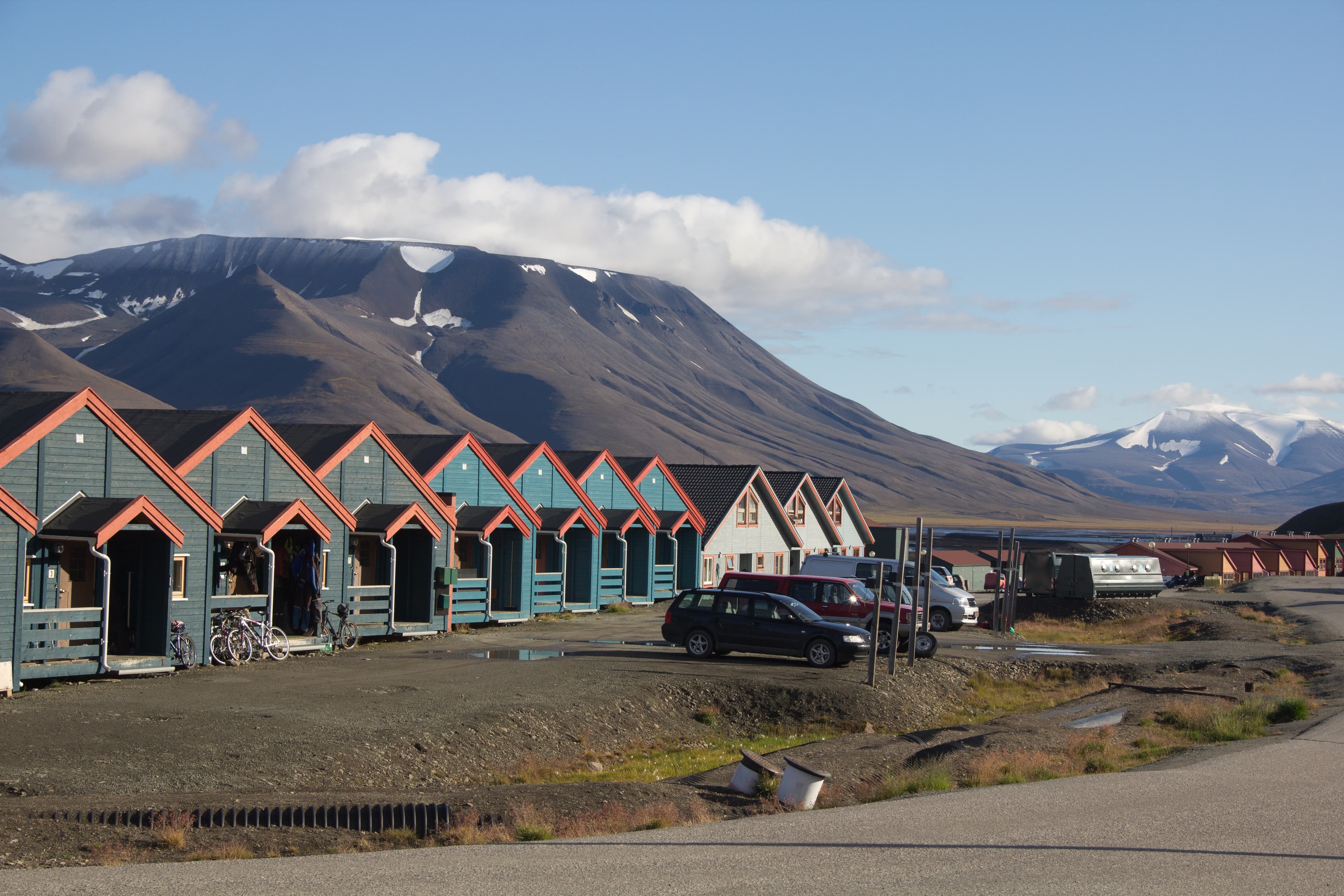
Our final expedition day will likely be spent in or around Isfjorden, the fjord system where Longyearbyen is located. The mountainous, glaciated scenery continues here, and we’ll spend much of the day exploring the coastlines—likely among seabirds. Isfjorden can also be an excellent place to spot whales, some of which may have arrived at their summer feeding grounds by now. Spend time on the outer decks taking in the scenery— you may spot various species of marine life. Our main goal today is to visit Alkhornet, the iconic seabird colony and also a good place to look for reindeer and Arctic fox. If conditions allow, we’ll make landfall, giving ourselves one last chance to set foot in this far northern wilderness. As we prepare to leave, we can appreciate the little auks, perfectly at home beneath the horn-shaped mountain overlooking the fjord, and the reindeer patiently awaiting summer’s abundant vegetation. They’ll remain here for a while, going about their daily lives in a vast wilderness that stretches in all directions for hundreds—if not thousands—of nautical miles.

The moment has come to say farewell. Time permitting, you may be able to explore the frontier-style settlement of Longyearbyen before the group transfer to the airport for the charter flight to Helsinki. Upon arrival in Helsinki, you’ll be transferred to your hotel for the night. Both are included in the Charter Flight & Hotel Package.

After breakfast, make your way independently to the airport for your onward flight home, or stay to explore Finland’s culturally-rich capital on your own.


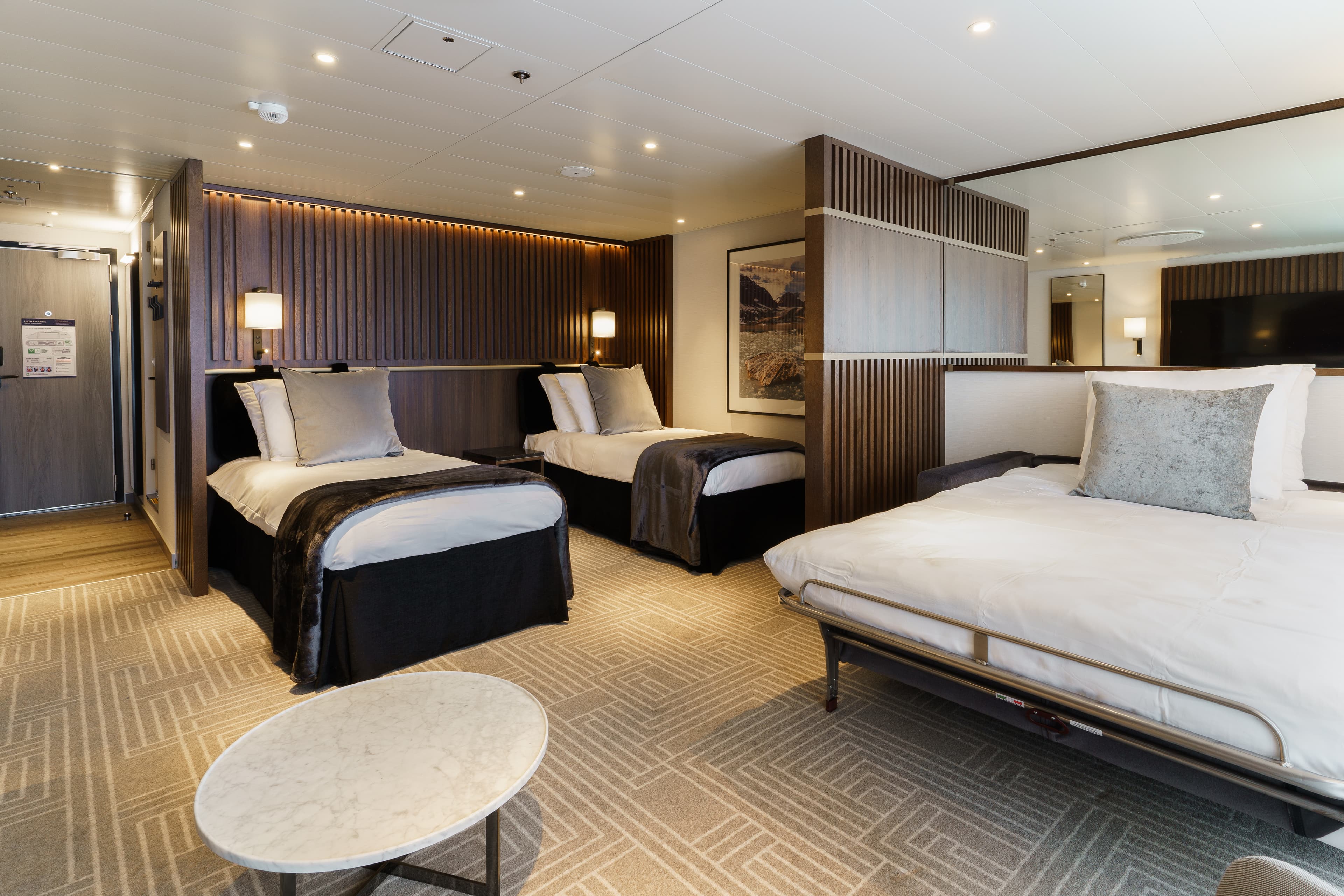
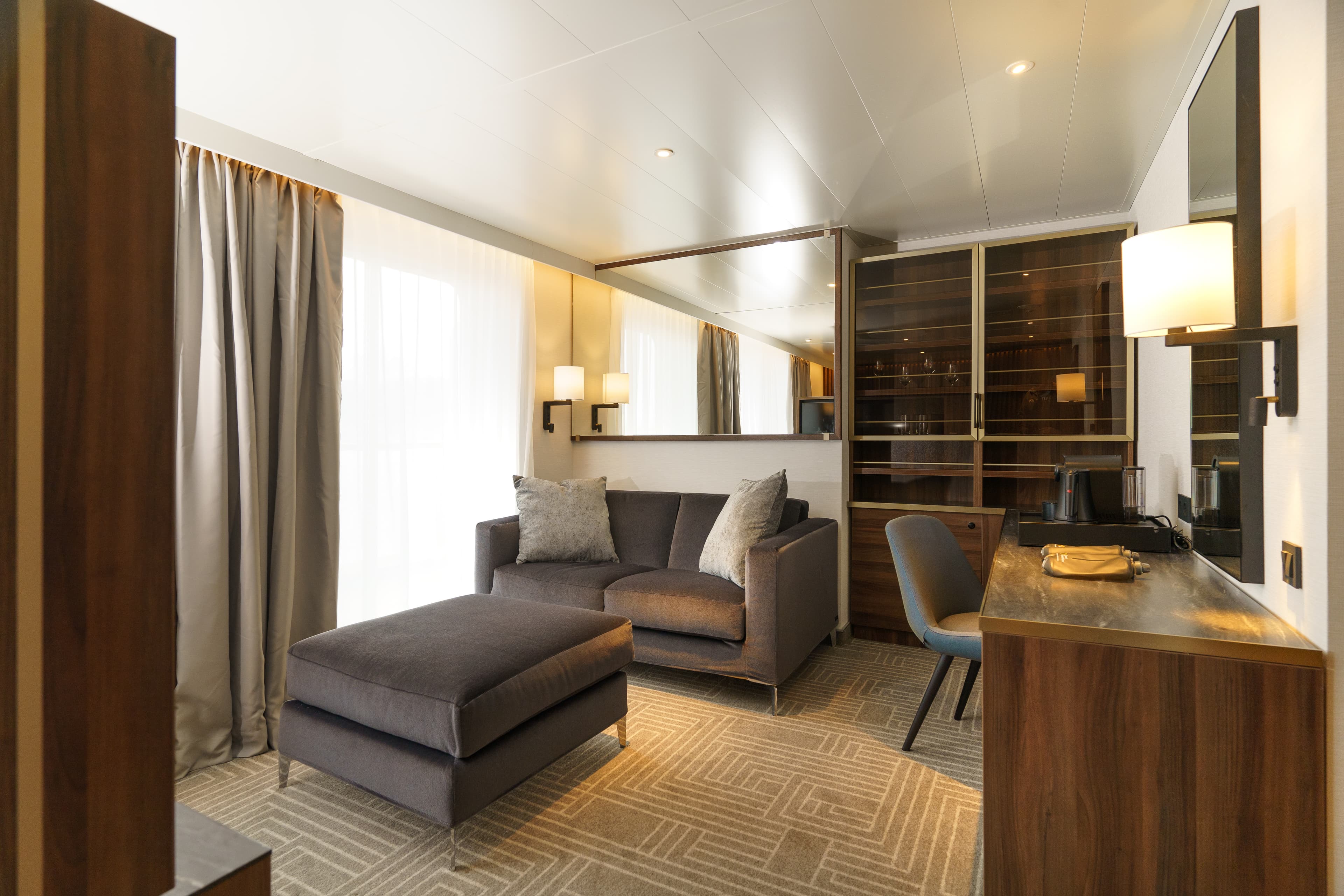
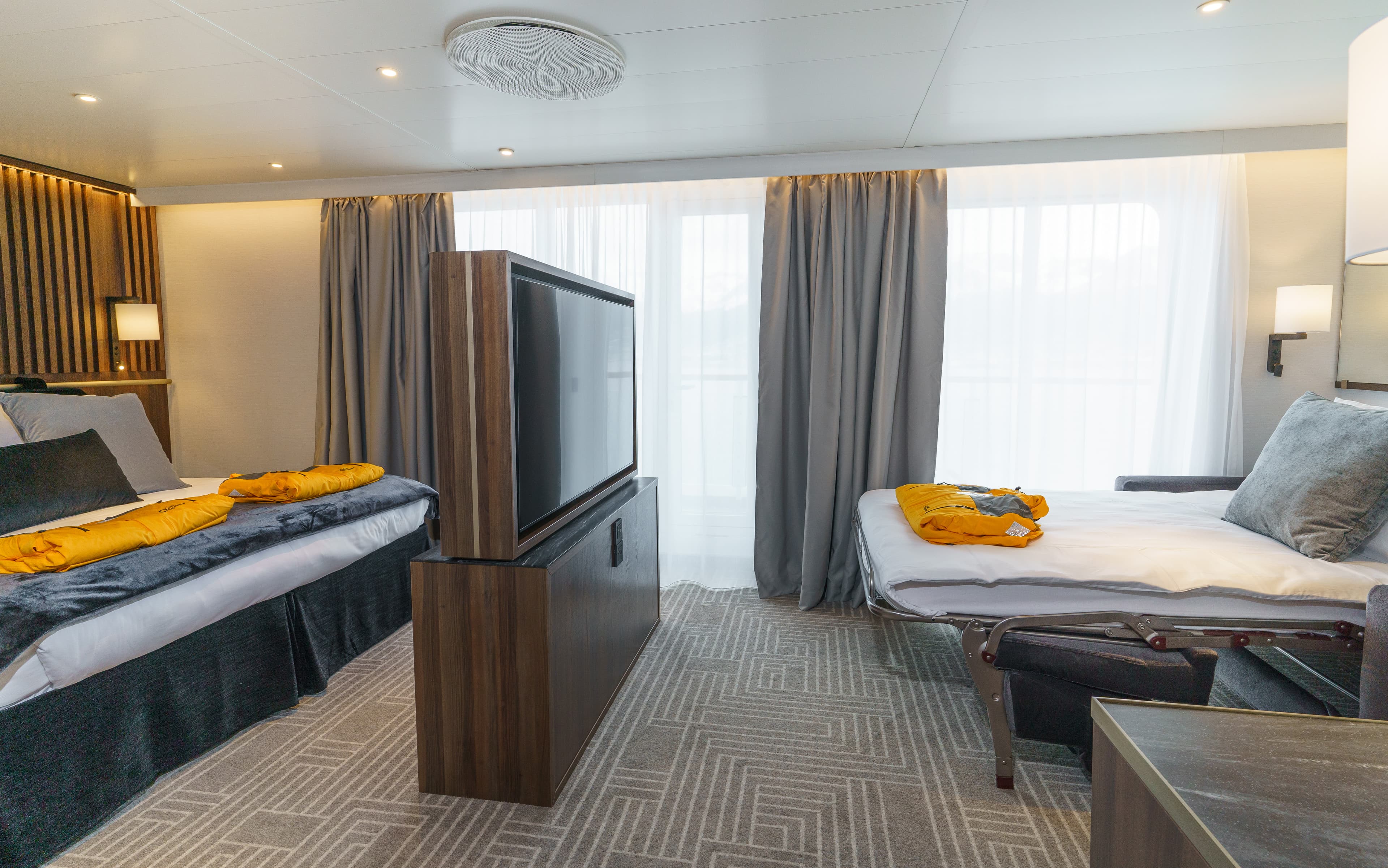
Introducing our sumptuous suite located on Deck 6, spanning an impressive 563 sq. ft. (52.3 m²) of interior living space complemented by a private 46 sq. ft. (4.3 m²) balcony. This suite epitomizes the essence of luxurious travel, designed for those who refuse to compromise on comfort or style. As our largest and most opulent suite, it offers unparalleled sleeping, entertainment, and storage spaces, making it an ideal choice for families or discerning travelers seeking the comforts of home while at sea. Inside, guests will find a private bedroom furnished with either a double bed or two singles, along with a spacious walk-in closet. The suite also features a cozy sitting area with a sofa bed and an additional walk-in hallway closet. The private balcony invites you to unwind in the fresh sea air, while the suite is equipped with thoughtful amenities including a desk, refrigerator, and TV. The luxurious bathroom provides a shower, bathtub with heated floors, and an additional powder room for added convenience. To enhance your experience, standard amenities such as a hairdryer, bathrobe, slippers, and essential bath products are provided, along with complimentary bottled water. For those seeking even greater comfort, premium amenities include upgraded bedding, in-suite coffee, and binoculars available for loan. Guests can enjoy onboard WiFi credit, included laundry services, in-suite dining during scheduled meals, and a complimentary spa package. Selected pre- and post-expedition hotel accommodations, as well as arrival transfers, may also be included for a seamless travel experience. Our suite is an invitation to indulge in the lavish lifestyle at sea, where every detail has been thoughtfully curated for your utmost satisfaction. Experience the pinnacle of cruise luxury in this exquisite suite, where your comfort is our priority.


位於第六甲板的豪華套房擁有約446平方英尺(41.4平方米)的室內生活空間及46.3平方英尺(4.3平方米)的私人陽台,完美為想要各種享受的旅客而設。這間寬敞的套房擁有獨立臥室、完整浴室、衛生間及兩個不同的生活空間,特別適合家庭或伴侶,在船上也能享受如家一般的舒適。 房間配置方面,私密臥室內可選擇一張雙人床或兩張單人床,並配有步入式衣櫥。寬敞的客廳提供沙發床及額外衣櫥,讓您無論是放鬆還是娛樂都能自如應對。套房內還擁有私人陽台、書桌、冰箱、電視、配有淋浴和浴缸的私人浴室,並且地板設施為加熱設計,讓您在寒冷的夜晚也能感受到溫暖。 為了提升您的住宿體驗,此套房還包含標準配備,如吹風機、浴袍、拖鞋、洗髮精、護髮素、沐浴露及免費水瓶。此外,升級的高端配備包括高級寢具、套房內咖啡及可借用的望遠鏡,讓您的旅程更加難忘。 服務方面,您將享有船上WiFi抵用金、包含的洗衣服務、定期的套房餐飲服務、贈送的水療套餐,以及在適用情況下的升級酒店住宿安排與到達接送服務,確保您的旅行充滿便利與舒適。


位於第七甲板的套房類別是本艘郵輪中最為獨特的選擇,擁有約369平方英尺(34.3平方米)的室內生活空間以及67平方英尺(6.2平方米)的私人陽台,專為渴望在床上享受無遮擋北極美景的旅客設計。該套房結合了壯觀的景色、寬敞的室內環境、完整的浴室及豐富的陽台空間,並且方便前往健身中心讓您全方位放鬆身心。房內配備雙人床或兩張單人床,舒適的座椅帶有沙發床,書桌、冰箱、電視以及設有淋浴、浴缸和加熱地板的私密浴室,為您提供無可匹敵的舒適體驗。此外,標準設施包括吹風機、浴袍、拖鞋、洗髮水、護髮素、沐浴乳和免費水瓶,而升級的床上用品及房內咖啡則為高級設施。郵輪內也提供WiFi可使用信用額度、包羅洗衣服務及在安排餐時提供的房內用餐服務,滿足高端旅客的需求。


坐落於艦艇第六層的這款套房,擁有約350平方英尺(32.5平方米)的室內空間及100平方英尺(9.3平方米)的陽台,非常適合渴望寬敞室內設計及寬大陽台的旅客。在第六層的中央位置,住客能享受到最小程度的移動感與晃動,令人倍感舒適。此房型配有一張雙人床或兩張單人床、沙發床的休息區、私密、寬敞的陽台、書桌、冰箱、電視及配有淋浴、浴缸和地暖的私人浴室。在標準設施上,您可享用吹風機、浴袍、拖鞋以及洗髮精、護髮素和沐浴露,同時提供的瓶裝水讓您水分充足。高級設施則包括升級的床品及房內咖啡。服務方面,還提供船上WiFi額度、免費洗衣及定時房內餐飲服務。這款套房不僅是一個舒適的休憩之所,更是享受海上旅程的理想選擇。


坐落於第4和第6甲板的豪華陽台套房擁有約299平方英尺(27.8平方米)的室內生活空間以及70平方英尺(6.5平方米)的私人陽台,特別適合追求寬敞居住環境的旅客。這款套房配置完整浴室及封閉式廁所,讓早晨的準備過程更加私密與便利,無論是與家人還是朋友一同出行都能舒適應對。房間內設有一張雙人床或兩張單人床、沙發床的休息區、書桌、冰箱及電視,並配備私密的浴室,內含淋浴、浴缸及地熱地板,使用起來更為舒適。此外,標準設施包括吹風機、浴袍、拖鞋、洗髮精、護髮素、沐浴露及免費水瓶,旨在為每位旅客提供極致的舒適體驗。


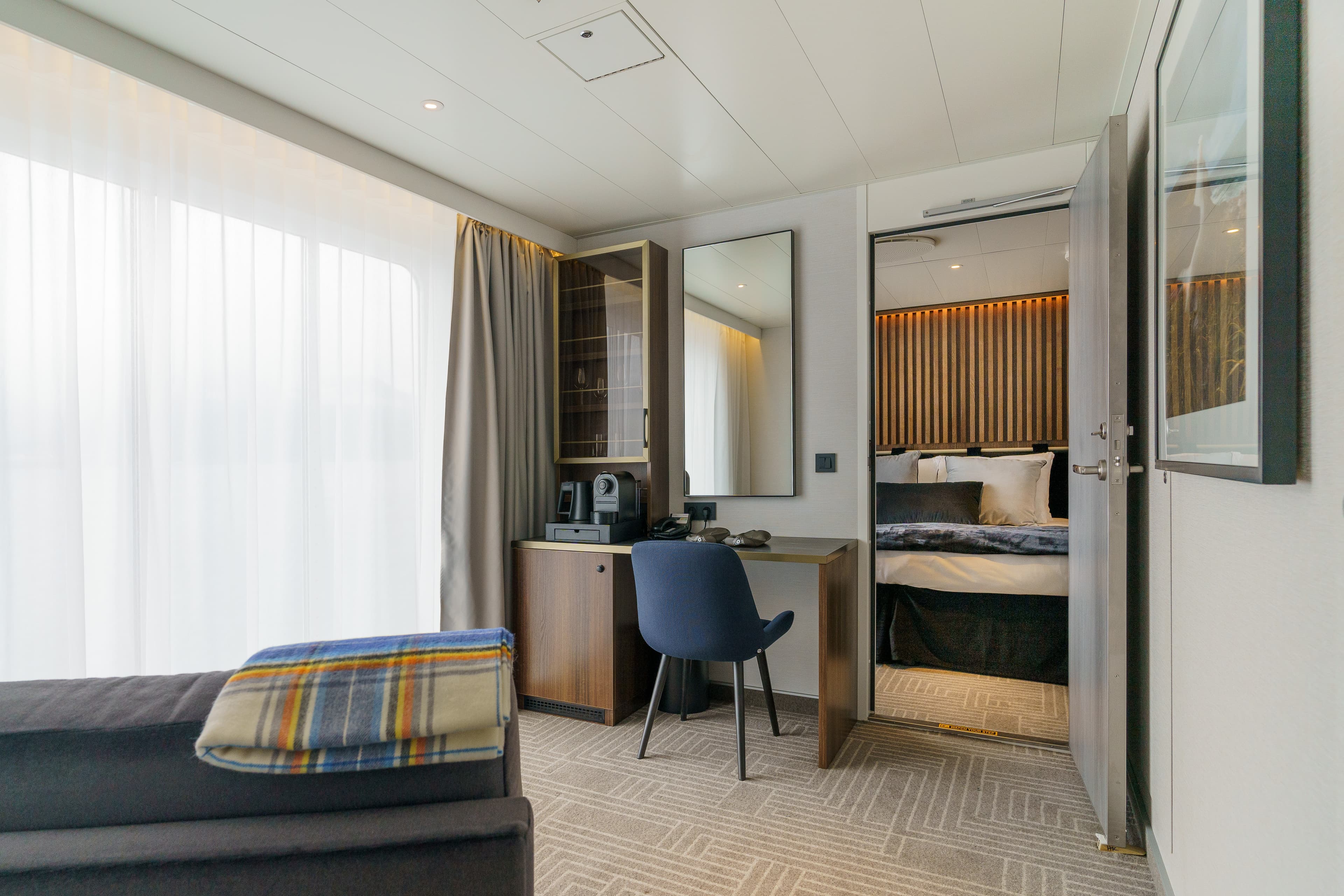
Experience the elegance of the Balcony Suite, strategically located on Decks 4 and 6. Spanning approximately 226 sq. ft. of well-appointed indoor living space, complemented by a generous 52 sq. ft. private balcony, this entry-level suite stands out as one of the most spacious options available on its class of ship. Tailored for guests seeking a harmonious blend of indoor and outdoor living, it serves as a perfect retreat. Families or groups can take advantage of the four connecting suites within this category, ensuring a seamless experience for those wishing to stay close during their journey. The suite features versatile sleeping arrangements with either a double bed or two singles, along with a cozy sitting area equipped with a sofa bed. Modern conveniences include a desk, refrigerator, TV, and a private bathroom with a shower and heated floors, ensuring comfort throughout your stay. Guests are also treated to standard amenities such as a hair dryer, bathrobe, slippers, and complimentary toiletries including shampoo and shower gel, alongside a complimentary water bottle for hydration on the go. Indulge in the ultimate relaxation experience aboard with the Balcony Suite, where luxury meets practicality.


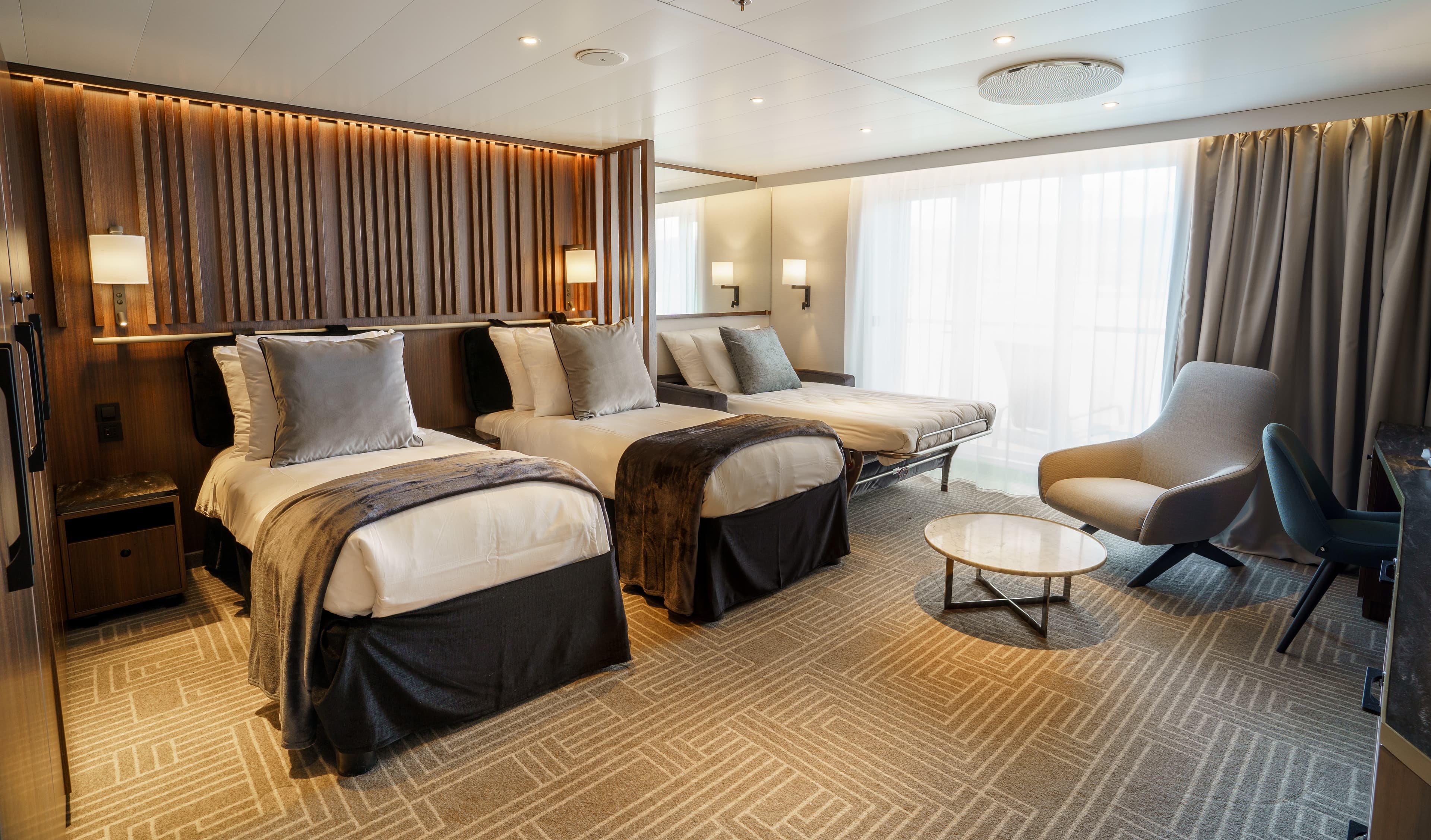
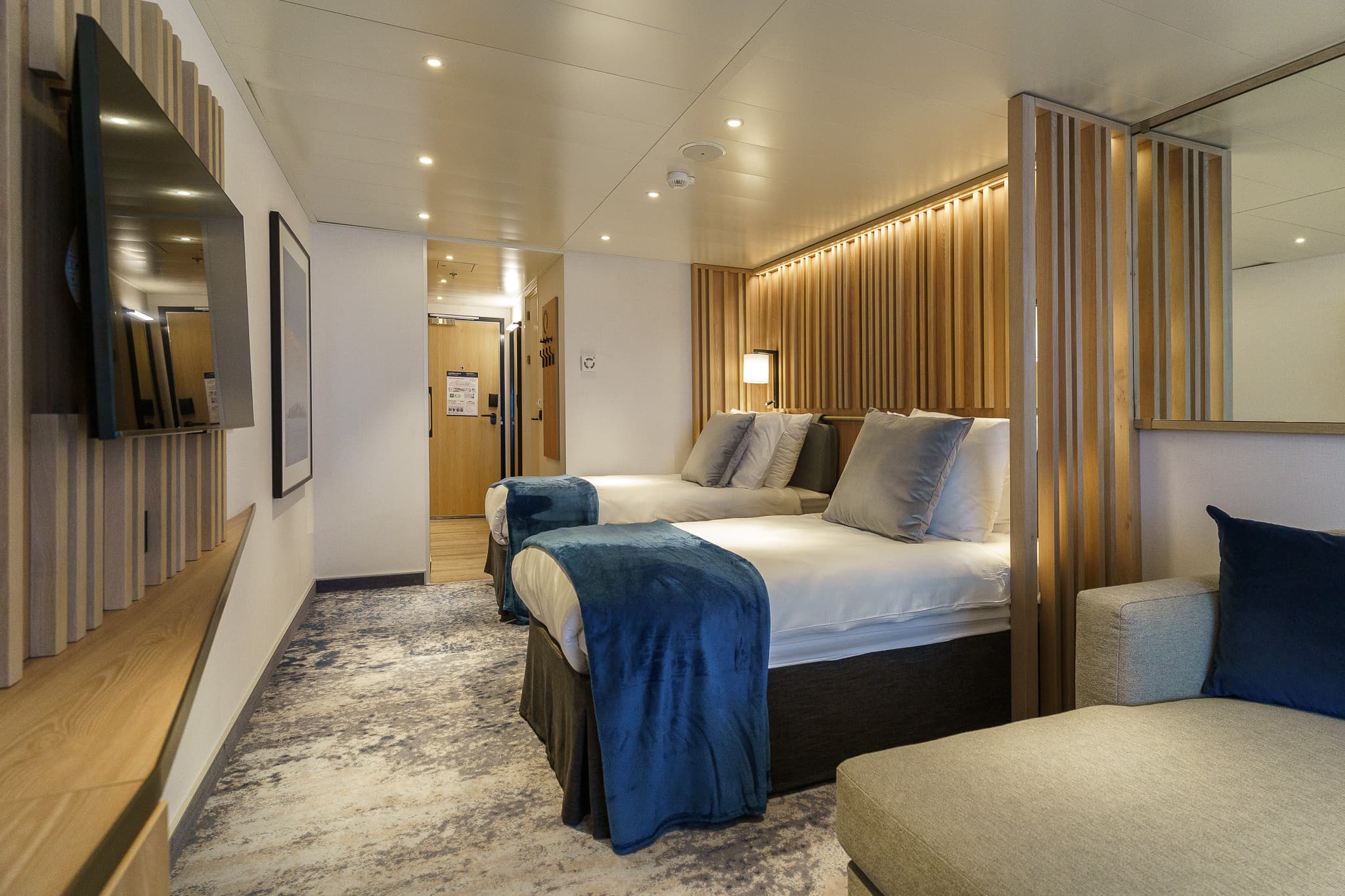
這間位於第三層甲板的雙人套房,面積約為285平方英尺(26.5平方米),非常適合共同旅行的夥伴或是希望與志同道合的人共享的單獨旅客。此套房充分利用室內空間,並讓住客能夠時刻與戶外環境保持連結。作為該艘郵輪同級別中最大型的入門級雙人套房,無論是休閒還是工作都能打造出舒適的居住體驗。 房間內設有一張雙人床或兩張單人床、帶沙發床的休憩區、窗戶景觀、書桌、冰箱、電視以及擁有淋浴設施和地暖的私人浴室。此外,配備完善的標準設施包括吹風機、浴袍、拖鞋、洗髮精、護髮素、沐浴露及免費的水瓶,為您的旅途增添便利與舒適。此房型可依需求選擇安排一張雙人床或兩張單人床,滿足每位旅客的需求。


位於第三層甲板的這間房型面積約為285平方英尺(26.5平方米),是獨自旅行的客人與志同道合的同伴分享美好時光的理想之選,或適合三人同行的朋友群體。房間內設有三張獨立的單人床,其中兩張可合併為雙人床,並配有每位客人所需的便利設施。此外,房型還設有舒適的休息區、景觀窗、書桌、冰箱及電視,並配備私人浴室,內有淋浴設施及地暖地板,為您提供奢華的舒適感。標準設施包含吹風機、浴袍、拖鞋、洗髮精、護髮素、沐浴露及免費礦泉水,讓您的入住體驗更為完美。


位於第六層的這間單人套房面積約132平方英尺(12.3平方米),非常適合珍視隱私的獨自旅行者,讓您可以在床上輕鬆欣賞壯麗的海景。這是同級別郵輪中唯一配備落地窗的單人套房,為您提供無與倫比的觀景體驗。房間內設有單人床、書桌、冰箱、電視及私人浴室,浴室內附有淋浴間及加熱地板,為您帶來無與倫比的舒適感。此外,標準設施包括吹風機、浴袍、拖鞋、洗髮水、護髮素、沐浴乳以及免費瓶裝水,讓您的入住更加方便與放鬆。這間套房融合了私密性與奢華感,讓您的郵輪之旅無疑成為一次難忘的體驗。